• Skip to primary navigation
  • Skip to main content
  • Skip to primary sidebar
  • Skip to footer

Pearson Strategy Group

Helping businesses look before they leap. - TM

  • HOW WE HELP
    • Overview of Services
    • Patent Searches
      • Innovation Strategy
      • Patent Analytics
    • Patent Searches for Patent Attorneys
    • Patent Alerts
    • Recognize Your Threats, Opportunities
      • Adjacent Technology Example
      • Emerging Technology Example
      • Disruptive Technology Example
    • Competitive Intelligence
    • Keep Up with Your Industry and Competition
      • Custom Market Research
    • Frequently Asked Questions
    • Additional Support
  • ABOUT
    • About Us
    • Meet the Founder
    • Alliance Partners
    • Philosophy
    • Trusted Suppliers
  • SUCCESS STORIES
  • CONTACT OUR EXPERTS
    • PRIVACY POLICY
    • TERMS AND CONDITIONS
  • NEWSLETTER
  • BLOG
  • Search

Has the Technology Life Cycle thrown you a curve?

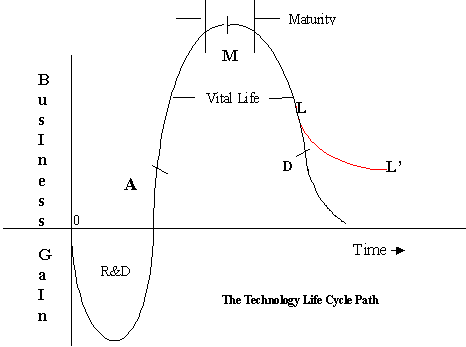
Technology Life Cycle

I made the case for scheduling time for strategy development in my post Do you give employees time to goof around? Some do!. I believe all companies should find the right balance for time spent on strategic thinking.

How does your company strategize to best use resources for your current technologies? How do you plan for the products that aren’t yet being considered for R&D?

The starting point for your answer lies with the technology life cycle curve. Every company is constrained by the technology life cycle which approximates how a company investing money on a new technology during the R&D phase can later recoup this money plus some profit during the maturity phase. The intent, of course, is that during the maturity phase your business reaps enough profit from the sale of products that the revenue generated exceeds the earlier R&D costs…the more so the better!

The methods for maximizing your returns lie in predicting and manipulating the variables: predicted cost, profit, and their durations. There’s no one right answer for any company or industry. (See Innovate, Inspire or Imitate – Where does your company operate?)

Since the ultimate goal for every company is to make money, a popular approach is to lengthen the duration of the money making “maturity” phase of the curve to as long as possible while minimizing R&D costs. This shortsighted plan will produce more money today at the expense of tomorrow’s profit.

The reverse model (long R&D phase with short maturity period) is more common to startup companies and can be dangerous as it could lead to an early bankruptcy.

For your company and its strategy, there is an appropriate mix of resource allocation between products in the maturity vs. R&D phase. Your choices will depend on several factors including your desired level of innovation and the amount of competition in your industry.

As these factors accelerate, the potential that someone else will disrupt your plans rises as emerging, adjacent and disruptive technologies can significantly alter the life cycle of your technology. These factors generally increase your risks, and yet, these risks can be mitigated through due diligence on your technology, IP and market space and by responding to change.

In conclusion, I recommend you plot each of your technologies on the technology life cycle curve to ensure your revenue stream both today and in the future.


Photo credit: Hermitage17 (Wikipedia)

Share this:

  • Share on Facebook (Opens in new window) Facebook
  • Share on X (Opens in new window) X
  • Share on LinkedIn (Opens in new window) LinkedIn
  • Share on Pinterest (Opens in new window) Pinterest
  • Email a link to a friend (Opens in new window) Email

Reader Interactions

Leave a Comment Cancel

Your email address will not be published. Required fields are marked *

sidebar

Blog Sidebar

Subscribe to Our Newsletter Overview of Our Services Schedule a Consultation

Recent Posts

  • Do You Really Need a Patent Attorney in Austin, Texas?
  • 50 Five-Star Google Business Reviews
  • Honoring Veterans with Discounts on Services
  • Presentation on Patent Data-Driven Innovation
  • Protecting Software Innovations: A Guide for Startups
  • Understanding Provisional vs Non-Provisional Patents: A Guide for Inventors
  • Pearson Strategy Group Celebrates 10 Years of Innovation

Footer

Let’s Talk

What to expect. Sample reports. Pricing.

  • This field is for validation purposes and should be left unchanged.

Recent News

Lawyer working on a laptop at desk.

Do You Really Need a Patent Attorney in Austin, Texas?

Do You Really Need a Patent Attorney in Austin, Texas? Why This Question Comes Up So Often Are you one of the many inventors who search the internet for “Patent Attorney in Austin Texas” or “Patent Attorney near me” when they have a Read More

50 Five-Star Google Business Reviews

We are honored to celebrate over 50 Five-Star Google Business Reviews. We are genuinely grateful to every client who has trusted us to support their strategy, innovation, and long-term growth. Your partnership fuels the work we do and motivates us to Read More

Social Media

FacebookYoutubeLinkedin


Privacy Policy | Terms and Conditions

Phone: 1-512-466-1450 | Email: innovate@pearsonstrategy.com

© 2026 Pearson Strategy Group, LLC. All Rights Reserved